
How to see sold prices on Rightmove
The short answer
Sold prices are public: HM Land Registry publishes what homes in England and Wales sold for, a few months after each sale. Public is not the same as usable, though. The record sits apart from the listing you are looking at, is searched a street or a postcode at a time, and comes back as a list of dates and prices, with no map, no distances and no floor areas. Property Track Plus puts it on the Rightmove listing itself: what sold nearby in the last six months, and the sold-price trend for the area.
Does Rightmove show sold prices?
Yes, but not where you need them. A listing is about the asking price; sold prices are kept in a separate part of the site, searched by street, town or postcode, away from the home you were looking at.
The figures are not Rightmove's own, either. Sales in England and Wales come from HM Land Registry, which supplies every standard residential sale since 1995, and sales in Scotland from Registers of Scotland; Northern Ireland is not covered. So what you find there is the public record in much the shape the register gives it: address by address, with nothing to say which sales are near enough, recent enough or similar enough to the home you are weighing up.
How to find out what a house sold for
- Open HM Land Registry's sold property prices search on GOV.UK. It is the official record, it is free, and it covers England and Wales. For Scotland, use ScotLIS.
- Enter the postcode, or the street and the town, and leave the other address fields empty.
- Find the address in the results, which give the date and price of each of its sales on record.
That tells you what one house sold for. It does not answer the question a buyer usually has, which is what homes like this one, near this one, have sold for lately.
Are house sale prices public record?
In England and Wales, yes. HM Land Registry publishes the price paid for residential property sold for value, back to 1995, as open data that anyone can search or download. That is why Rightmove, Zoopla and every other site show the same figures: they all take them from the same register.
Not every transfer is in it. A sale has to be for value and lodged for registration, so gifts, right-to-buy sales and transfers under a court order, among others, are left out.
Why isn't a recent sale showing yet?
Because sold prices run behind the market. HM Land Registry says the time between a sale and its registration typically ranges from two weeks to two months, it publishes once a month, and it warns that the two most recent months are always incomplete. Rightmove then adds each month's file to its own pages. In practice a sale shows up a few months after it completes.
A listing marked “Sold STC” is earlier still: an offer has been accepted, at a figure nobody publishes. The price becomes public only after the sale completes and is registered.
Sold price or asking price: which should you go by?
Both, because each is missing what the other has. A sold price is what the market actually paid, but it is months old and belongs to a different home. An asking price is live, but it is a claim, and Rightmove never shows how it has changed - our guide on how to see price history on Rightmove covers that half. For putting the two together, see how to check if an asking price is fair.
What Rightmove and Land Registry leave out
The figures are all there. What is missing is everything that would make them useful while you are looking at a home.
- The listing. Both are separate searches. You leave the home you were looking at, type its street or postcode in again and set the property type and dates yourself, and what comes back knows nothing about the listing you came from.
- Distance. A radius, where there is one, is measured from the street or postcode you typed, not from the home. Land Registry's search has no map and no distances at all: it is a form of address fields and a list of dates and prices. Which sales are near enough to matter is left to you.
- Size. The register records a price, a date, an address, a property type, whether the home was a new build and whether it is freehold or leasehold. It has no floor area and no number of bedrooms, so a £600,000 flat could be 550 square feet or 900, and price per square foot cannot be worked out from it.
None of that is a fault in the data. It was published as a record of transactions, not as a tool for weighing an asking price, and that is how it reads.
How to see sold prices on the Rightmove listing itself
Property Track Plus, a paid subscription from £4.99 a month, fills those gaps by starting from the listing. Its Recent sales tab shows every sale within a quarter, half or one mile of the home you are looking at in the last six months, newest first, from HM Land Registry: the address, the property type, the price paid and how far it is from the listing, on a map or as a list.
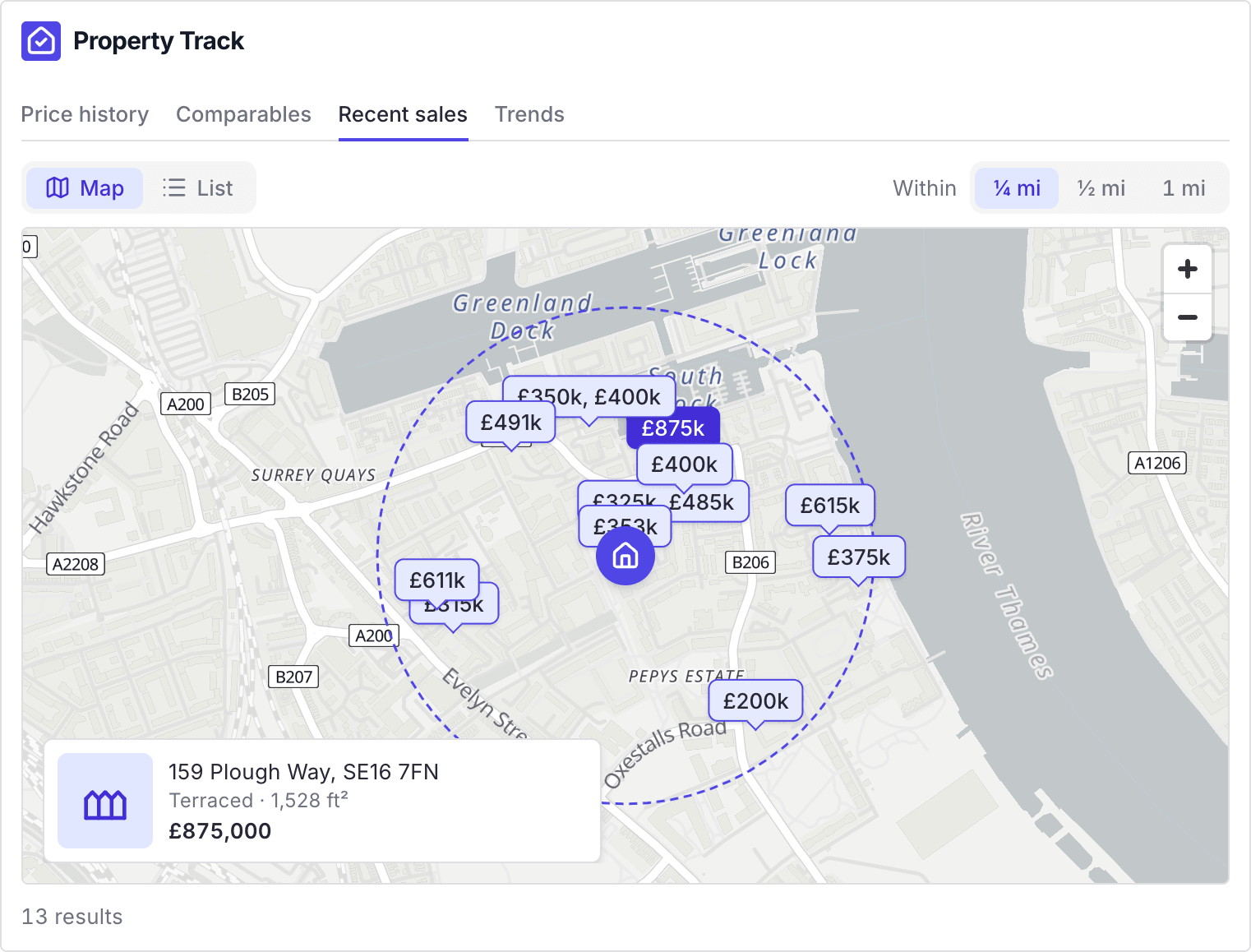
Where the register of energy performance certificates has a certificate that matches the address, the sale also carries its floor area, so you can compare price per square foot rather than headline prices. A sale with no matching certificate is left without a size rather than given a guess.
The Trends tab takes the longer view: the median sold price and the number of sales in the listing's outcode, by property type, for every complete year back to 1995.
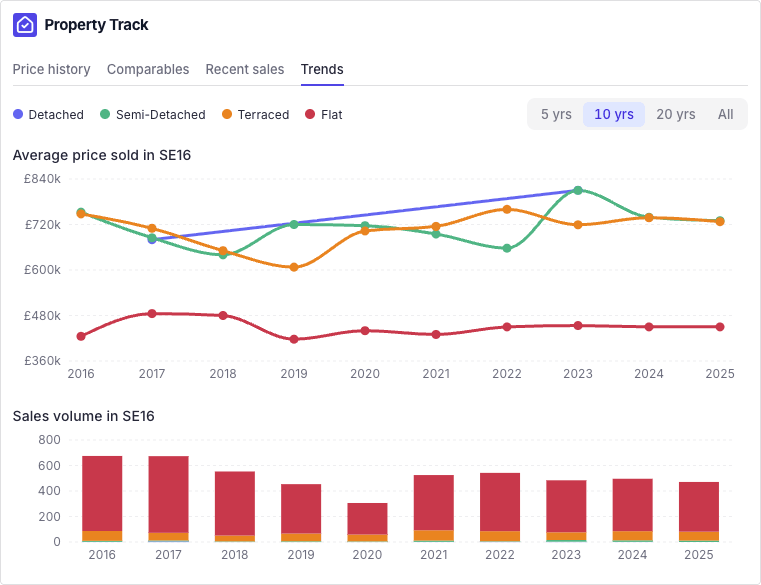
Both tabs use HM Land Registry data, so they cover England and Wales, and they run as far behind as the register does. The asking-price history beside them is free, with no account.
Know what to offer with Plus
Price history shows what the seller has asked. Property Track Plus adds three tabs beside it, so you can weigh the asking price against the market around the home.
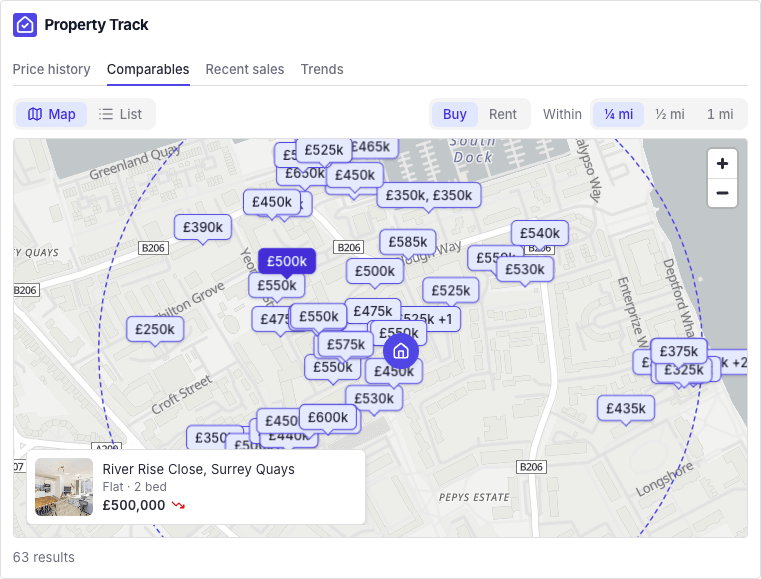
- Comparables
- Homes for sale or to rent nearby with the same number of bedrooms, and whether their prices have been cut.
- Recent sales
- What actually sold nearby in the last six months, and for how much, from HM Land Registry.
- Trends
- Sold prices and the number of sales in the outcode, every year back to 1995.
From £4.99 a month, billed annually. Price history stays free.
Frequently asked questions
- How often does Rightmove update sold prices?
- Monthly. HM Land Registry and Registers of Scotland each publish their sales once a month, and Rightmove adds them to its own pages after that. The latest two months are always incomplete, because sales are still being registered.
- Why can't I find what a house sold for?
- Usually because the sale is too recent: HM Land Registry says registration typically takes between two weeks and two months, and the price is published only after that. Sales that were not for full value, such as gifts, right-to-buy sales and transfers under a court order, are never published.
- How do I find out how much my neighbour's house sold for?
- Search your street or postcode in HM Land Registry's sold price search on GOV.UK, which is free and lists the published sales at each address since 1995. With Property Track Plus, the Recent sales tab on any Rightmove listing near you shows what sold within a mile of it in the last six months, on a map.
- Does a 'Sold STC' listing show the price it sold for?
- No. Sold subject to contract means an offer has been accepted, and nobody publishes that figure. The price paid becomes public only once the sale has completed and been registered, usually a few months later.
- Can I see sold prices in Scotland and Northern Ireland?
- Yes, from their own registers. In Scotland, sold prices are published by Registers of Scotland, whose search is ScotLIS. In Northern Ireland, Land and Property Services publishes house price information. Property Track Plus's Recent sales and Trends tabs use HM Land Registry data, so they cover England and Wales only.
- Does Property Track show sold prices for free?
- No. The asking-price history on every Rightmove listing is free, with no account. Recent sales and Trends, the two tabs with sold prices, are part of Property Track Plus, a paid subscription.