
How to see price history on Rightmove
The short answer
Rightmove doesn't show a listing's price history - at most you'll see a ‘Reduced’ label with no amounts. To see every asking-price change, install the free Property Track extension for Chrome, Firefox or Edge and the full history appears on the listing itself. What homes nearby actually sold for is a separate, public record, which Property Track Plus puts on the listing as well.
Does Rightmove show price history?
Only barely. A Rightmove listing shows an “Added on” date, and if the asking price has been cut it swaps to “Reduced on” with the date of the most recent reduction. What it never shows is the actual history: what the property was originally listed at, how many times the price has changed, or by how much.
It gets worse: those dates reset. If an agent removes a property and relists it - a common tactic for stale listings - the “Added on” date starts again and the “Reduced” label disappears. A property that has been struggling to sell for a year at ever-lower prices can look box-fresh.
How to see the full price history on any listing
The simplest way is a browser extension that has been recording listing data over time, so it can show you what Rightmove won't:
- Install Property Track for Chrome, Firefox or Edge. It's free, with no signup and no limits.
- Browse Rightmove as usual and open any listing.
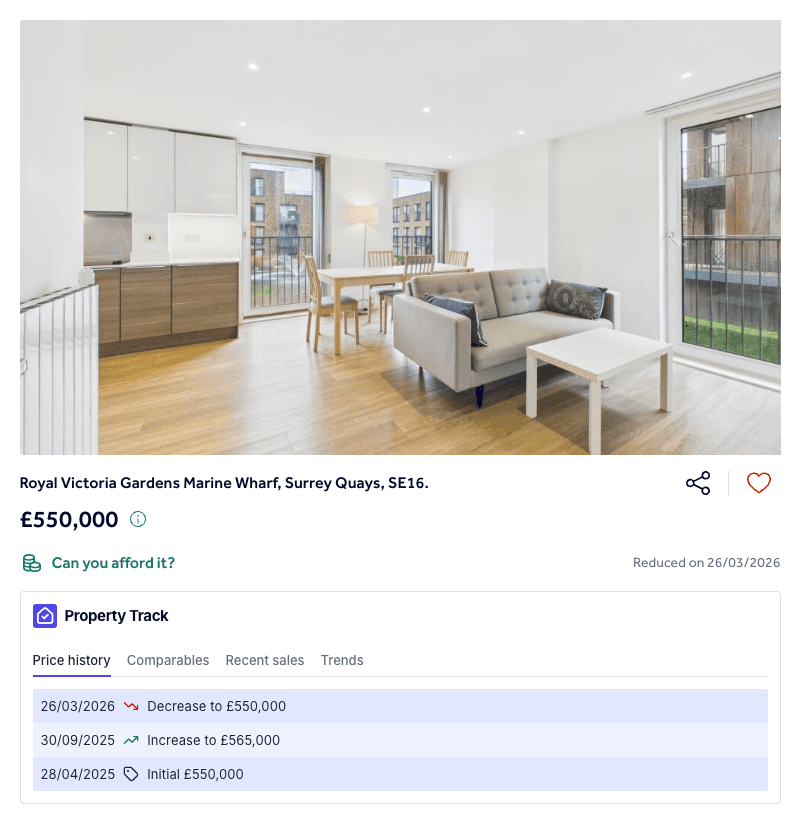
- The full asking-price history appears on the page - the price it was first listed at and every change since, with dates and amounts.
 Download on Chrome
Property Track has tracked over 8 million UK listings since October 2023. Other tools also track price history - see our comparison of the best Rightmove extensions if you want to weigh up the options.
How to see when a property was first listed on Rightmove
The “Added on” date at the top of a listing only lasts until the first price cut. After that it reads “Reduced on” with the date of the latest cut, and the day the home was first listed is gone from the page. The only reliable way to know when a listing first came to market is a tool that has been watching the market continuously. Property Track records each listing from the day it first appears in Rightmove's search results, so for anything that has come to market since it started in October 2023, the first line of the price history is the original listing date and price, whatever the label says now.
How to see how long a property has been on the market
Time on market is one of the strongest negotiating signals there is. The average UK property that sells does so within a few months; one that has been listed for six months or more - especially with price cuts along the way - usually has a seller who is far more open to offers. Add the true first-listed date (above) to the price history and you can tell at a glance whether you're looking at a fresh listing at a tested price, or a stale one still priced at hope.
How to see price reductions on Rightmove
Rightmove marks reduced listings with a “Reduced on” label in search results, but it won't tell you the size of the cut - a £1,000 trim and a £100,000 drop look identical. With price history visible, you can see the amount and date of every reduction, which tells you both how motivated the seller is and how the market has responded to each price point.
Can you see old or previous Rightmove listings?
Only for homes that went on to sell. Rightmove has no archive of old listings to browse, and once a home is sold or withdrawn its listing comes down. For a home that sold, though, its House Prices section keeps the photos and floor plan from the last time it was listed, beside the price it sold for. What Rightmove never kept is the listing history buyers ask about - when it was first listed, at what price, and each change since.
What you can see is the history of any listing that is still live. Property Track has been recording asking prices from Rightmove's search results since October 2023, for sale and to rent, and shows each listing's history on the listing itself. It keeps prices and dates rather than photos or descriptions, and it keeps them per listing: a home that comes back as a brand-new listing, often under a different agent, starts a new history.
Can you see the price history of sold houses?
Yes - but that's a different record. Once a sale completes, the price paid is public, published by HM Land Registry a few months afterwards. Public is not the same as usable, though. The register is searched a street or a postcode at a time, through a form of address fields, and what comes back is a list of dates and prices: no map, no distances, no floor areas, and no idea which listing you were looking at.
Property Track Plus, a paid subscription, puts it where you need it. Beside the price history on the listing, it adds what sold within a quarter, half or one mile in the last six months, with floor areas where an energy certificate gives them, the sold-price trend for the area back to 1995, and the similar homes on the market nearby now. Together they show what the seller asked, how they cut, what the competition is asking and what the market actually paid. Our guide to sold prices on Rightmove covers the record itself, and what it leaves out.
Why price history matters when buying
An asking price is a claim, not a fact. A property quietly reduced by £50,000 over eight months tells you the market has already rejected the higher prices - information worth real money in a negotiation, and invisible on the listing itself. Price history turns “offers over” theatre back into evidence: you can see what the seller believed, when they blinked, and how far they've already come.
It is one piece of evidence of three. Our guide on how to check if an asking price is fair sets it beside the other two: what similar homes nearby are asking, and what they have sold for.
Frequently asked questions
- Is there a free way to see Rightmove price history?
- Yes. The Property Track browser extension shows the full asking-price history on every Rightmove listing in Chrome, Firefox or Edge, free, with no account, card or search limits.
- Can I see Rightmove price history without an extension?
- Only in part. Rightmove gives the date of the latest reduction but not its size or the prices before it, and its House Prices section shows what a home sold for and the photos from its last listing, not what it was listed at. Seeing every asking price takes a tool that recorded the listing over time, which is what the Property Track extension does.
- Why does a Rightmove listing say 'Reduced'?
- Because its asking price has been cut at least once. The label carries the date of the latest cut, but not how big it was or how many came before it, so a £1,000 trim and a £100,000 drop look the same.
- What does it mean when a property is relisted on Rightmove?
- The agent has taken the home off Rightmove and put it back as a new listing. The 'Added on' date starts again and any 'Reduced' label goes, so a home that has been for sale for a year can look new. A new listing starts a new price history in Property Track too, so if a fresh listing looks familiar, ask the agent how long the home has been for sale.
- Does Rightmove show the price history of rentals?
- No. A rental gets the same 'Reduced' label with no amounts. Property Track records rents as well as sale prices, so a home to rent on Rightmove shows every change to its monthly rent.
- Can you see price history on Zoopla?
- Partly. Zoopla shows a listing history on many of its own listings, with the first listed price and later changes. Rightmove has nothing like it, which is the gap Property Track fills. Property Track works on Rightmove only.
- Can I see Rightmove price history on my phone?
- Not with a browser extension - extensions only run in desktop browsers. Property Track works in Chrome, Firefox and Edge on Windows, Mac and Linux, but cannot run inside the Rightmove mobile app.