
How to check if a Rightmove asking price is fair
The short answer
An asking price is what the seller hopes for, and nothing on a Rightmove listing tells you whether it is fair. To judge one, set it against three things: how the price has moved since the home was listed, what similar homes nearby are asking now, and what similar homes nearby actually sold for. The first is free with the Property Track extension; Property Track Plus puts the other two on the listing as well.
Is there a Rightmove price checker?
Not for a listing. Rightmove has an instant online valuation that estimates what a home is worth from its address, which is built for owners and, as Rightmove says itself, cannot see inside the home. Agents have a Best Price Guide report for pricing a home they are about to list. A buyer looking at a listing gets the asking price and nothing to weigh it against.
So checking a price means gathering the evidence yourself. There are three kinds, and each covers for what the others miss.
1. What has the seller already done to the price?
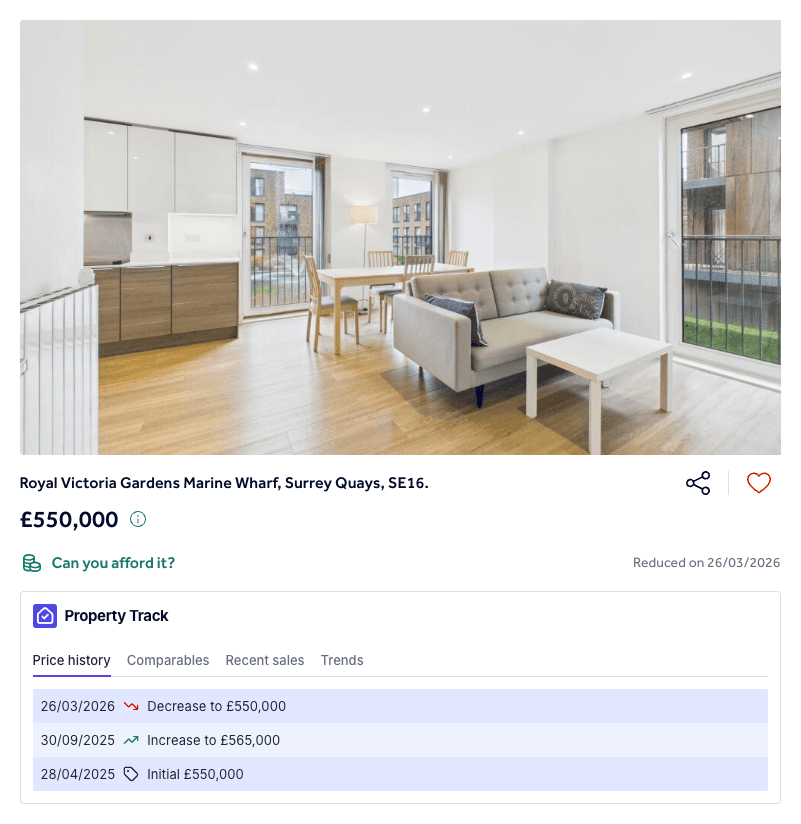
Start with the listing's own history. A home that came on at £550,000 eight months ago and has been cut twice to £500,000 is a different proposition from one listed at £500,000 last week, and on Rightmove the two look the same: at most a “Reduced” label, with no amounts.
The free Property Track extension shows every change to the asking price, with its date, on the listing and under each search result. Our guide on how to see price history on Rightmove goes through what it tells you.
 Download on Chrome
2. What are similar homes nearby asking?
Next, the competition. By hand, that is a Rightmove search for the same number of bedrooms within a quarter or half a mile, opened listing by listing. It works, but it is slow, and it cannot tell you which of those homes have had their own prices cut.
The Comparables tab in Property Track Plus, a paid subscription from £4.99 a month, does it on the listing: every home on the market within a quarter, half or one mile with the same number of bedrooms, for sale or to rent, newest first, on a map or as a list. Each shows its latest asking price and whether it has been cut or raised, and from what.
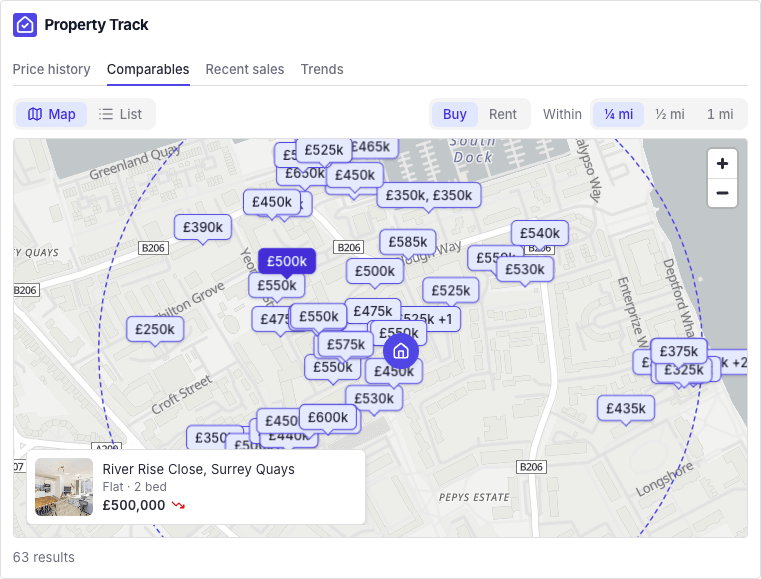
Remember that these are asking prices too. A street where every similar home is priced below the one you are looking at is a question for the agent; a street where half of them have been cut tells you which way sellers are having to move.
3. What did similar homes actually sell for?
Sold prices are the only figures somebody really paid, and they are public, from HM Land Registry. The trouble is getting them into a shape you can use.
Rightmove keeps them in a separate House Prices section, so you leave the listing, type its street or postcode in again and set the filters yourself. What comes back is centred on the place you typed rather than the home you were looking at, address by address, for you to sift for the few sales that are recent enough, near enough and similar enough to matter. Land Registry's own search is plainer still: a form of address fields and a list of dates and prices, with no map, no distances and no floor areas. Our guide to sold prices on Rightmove covers both, and why they run a few months behind.
That is the work Plus does: it puts sold prices in front of the listing they are evidence for. The Recent sales tab starts from the home you are looking at, and shows every sale within a quarter, half or one mile of it in the last six months, newest first, on a map or as a list. Each has its address, its property type, the price paid and how far it is from the listing, and where its energy performance certificate gives one, its floor area.
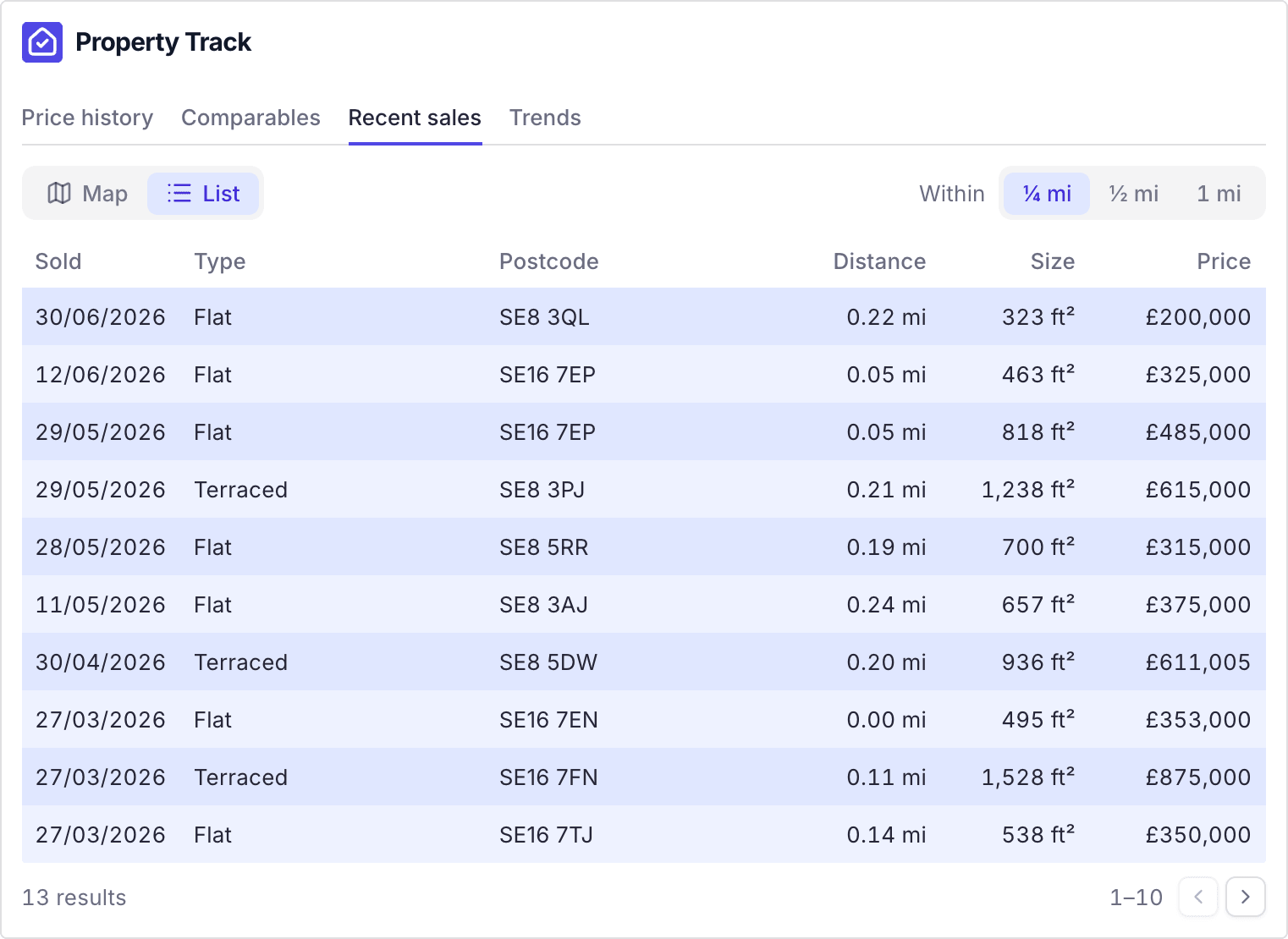
Floor area is what makes a comparison fair. Two two-bed flats can differ by a third in size, so compare price per square foot, not headline prices: divide each sold price by its floor area, and do the same for the listing, whose size is usually on its floor plan or its energy performance certificate.
4. Which way is the area moving?
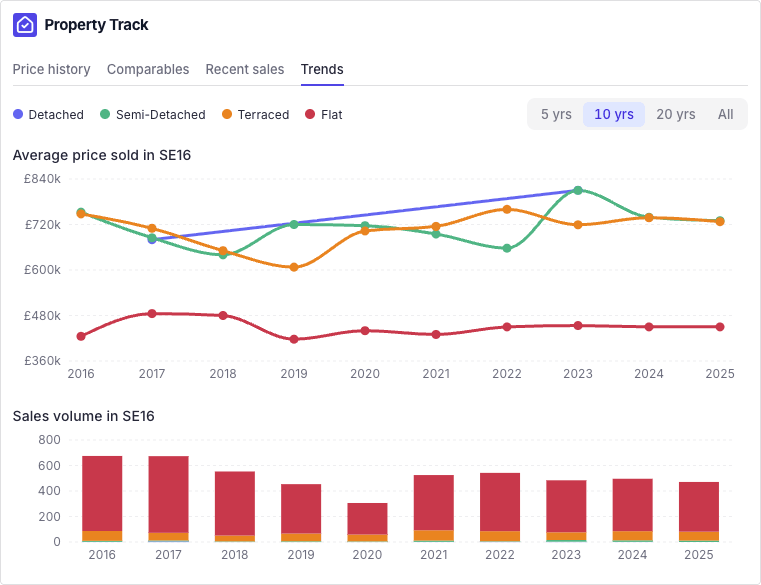
Recent sales are a snapshot; the trend says which way to lean. The Trends tab shows the median sold price and the number of sales in the listing's outcode, by property type, for every complete year back to 1995. Prices that have been flat for three years, or sales that have thinned out, give an ambitious asking price less to stand on.
Putting it together
- Cut more than once, and months on the market: the seller is already moving towards the market. The history shows how far they have come.
- Priced above every similar home nearby: there should be a reason you can see, such as size, condition or outside space. If there is not, the price is the reason it is still for sale.
- Price per square foot well above recent sales: the same question, asked of what buyers actually paid.
- Freshly listed, in line with both: there is little room, and a low offer is unlikely to be the one that wins.
None of this is a valuation. It will not tell you about the condition of the home, the length of a lease or what a survey might find, and a mortgage lender will send its own surveyor. What it gives you is what the agent already has: the evidence behind the number.
Know what to offer with Plus
Price history shows what the seller has asked. Property Track Plus adds three tabs beside it, so you can weigh the asking price against the market around the home.
- Comparables
- Homes for sale or to rent nearby with the same number of bedrooms, and whether their prices have been cut.
- Recent sales
- What actually sold nearby in the last six months, and for how much, from HM Land Registry.
- Trends
- Sold prices and the number of sales in the outcode, every year back to 1995.
From £4.99 a month, billed annually. Price history stays free.
Frequently asked questions
- Is there a Rightmove price checker?
- Not for a listing. Rightmove has an instant online valuation that estimates what a home is worth from its address, built for owners, and a Best Price Guide report that agents use to price a home. Nothing on a listing says whether its asking price is fair, so checking one means comparing it yourself: with its own price history, with similar homes for sale nearby, and with recent sold prices.
- Does Property Track value a property?
- No. Property Track shows evidence, not a valuation: the listing's asking-price history, free, and with Plus the comparable homes on the market nearby, recent sold prices and sold-price trends. A valuation for a mortgage comes from the lender's surveyor.
- How much below the asking price should I offer?
- There is no standard percentage. It depends on the evidence: how long the home has been listed, whether the price has already been cut, what similar homes nearby are asking, and what similar homes have recently sold for. A fresh listing priced in line with recent sales has little room; one that has sat for months above its comparables has more.
- How do I work out price per square foot?
- Divide the price by the floor area. A listing's floor area is usually on its floor plan, or on its energy performance certificate, which you can look up free on GOV.UK. Comparing price per square foot stops a large two-bed and a small one being treated as the same home.
- Can I check whether a rent is fair?
- Yes, the same way. Property Track's free price history covers rental listings, so you can see whether a rent has been cut. With Plus, the Comparables tab can be switched to homes to rent, which shows the monthly rent of every similar home nearby and whether it has changed.
- Does this work outside England and Wales?
- Partly. Price history and Comparables work wherever homes are listed on Rightmove. Recent sales and Trends use HM Land Registry data, which covers England and Wales only.